Right now, 60% of Google searches end without anyone clicking a link.
That single stat should be enough to make you rethink your old SEO strategy.
Let’s be honest, we’re all turning to ChatGPT, Grok, Perplexity, and Google’s AI overviews for direct answers instead of scrolling through 10-20 blue links.
If your marketing isn’t built for that shift, you’re going to miss out on a growing audience.
That’s where GEO comes in.
What Is GEO?
GEO, or generative engine optimization, is the practice of structuring your content so AI search tools like ChatGPT, Perplexity, and Google AI Overviews can find it, understand it, and cite it directly in their answers.
Think of it as the next stage of SEO for the AI era.
SEO gets you ranked. GEO gets you quoted 👇
The term is gaining traction with SEO experts and marketers who need a way to separate two different goals: making your content visible to AI, and making your links rank high on a search results page.
You still need SEO. GEO doesn’t replace it.
It simply complements it and opens your content up to a new audience.
GEO vs. SEO: How They’re Similar
SEO and GEO have a lot in common.
Both are optimization tactics built to make your website and content more visible in online searches. Both depend on high quality, relevant content.
Both rely on understanding user intent to drive traffic to your site.
Here’s something worth noting
Most major AI platforms, even the ones not built by Google, Anthropic or Microsoft, still rely on established search engines for their general queries.
That means the pool of information isn’t drastically different no matter where someone asks their question, whether it’s Google, Perplexity, Bing, or ChatGPT.
Your content has just as much potential to show up in a ChatGPT answer as it does in a Perplexity one.
But none of that happens automatically.
Your content has to be optimized so AI models find it understandable and worth referencing.
It needs to be clear, credible, useful, and trustworthy.
It’s not enough to match a user’s question or stack the right keywords. AI search wants a reliable source it can pull from directly.
GEO vs. SEO: The Key Differences
There are four key differences that should shape how you approach content going forward.
1. Target
SEO targets traditional search engine results pages (SERPs – the 10 blue links page). GEO targets AI-generated responses, whether that’s Google’s AI overviews or apps like ChatGPT.
GEO is about getting referenced inside the AI’s answer, not about landing your link on a results page.
2. Ranking Factors
SEO builds ranking through keywords, backlinks, and technical SEO elements that help search crawlers find your content. Quality still matters, but since your content won’t appear on the results page itself, it doesn’t need to be narrative.
That’s why things like alt tags and hashtags work well for SEO. They help the engine recognize and recommend your content.
GEO works differently.
It leverages content structure, authority, and citations to make your content attractive to AI platforms. AI needs to understand your content well enough to cite it as a source and use it to give the user a complete answer.
Your content becomes a resource, not just a recommendation, so it needs real expertise behind it.
3. Traffic
SEO has always been click driven. The whole point was getting someone to click through from the results page to your site.
AI platforms and overviews are designed to summarize information without sending the user anywhere. Because of that, GEO focuses on exposure driven traffic.
You build brand visibility through mentions in AI responses, which can lead to indirect traffic rather than a direct click.
4. Content Strategy
SEO targets your whole website or webpage, using technical SEO, keywords, and backlinks to boost rankings for the entire page. GEO prioritizes the actual content itself.
The goal is making sure that content can be retrieved by AI systems without needing the full page for context.
For strong GEO, write context-rich pieces that stand on their own and are easy for AI to understand and quote. A clear question and answer format works well here.
It lets AI match the question to its query and use your answer as a direct explanation.
How to Actually Optimize for GEO
GEO is here and it’s not going anywhere, so here is how to optimize your content for generative AI:
- Lead with the answer. Open each section with a direct, quotable answer to the question in the heading, then follow up with supporting detail. AI tools tend to pull the first clear statement in a section, so don’t bury the point.
- Use a question and answer structure. Phrase your headings as real questions people would type or speak into an AI tool, then answer them plainly underneath.
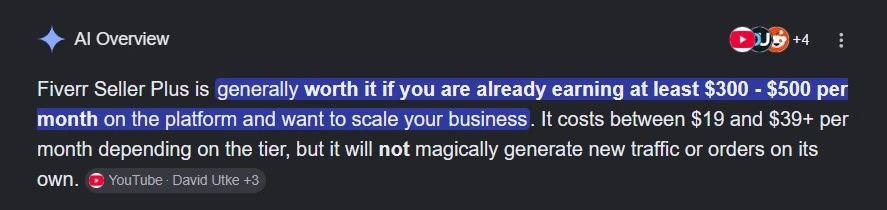
- Back up claims with specifics. Data points, named sources, and expert quotes give AI a reason to treat your content as credible enough to cite. My Fiverr example is an obvious example because I’m actually a top rated seller.
- Keep sections self-contained. Each paragraph should make sense on its own, without needing the rest of the page for context. AI tools often pull isolated passages rather than whole pages.
- Don’t ignore the technical basics. Make sure your content isn’t blocked by your robots.txt file, isn’t hidden behind a login or paywall, and loads without relying entirely on JavaScript. If AI crawlers can’t read your page, none of the above matters.
Not everyone agrees GEO is its own discipline
Google’s own developer documentation has pushed back on some of these tactics, saying that for Google Search specifically, this is really just good SEO under a new name, and that things like special AI text files aren’t necessary.
Personally, I’ve not changed my approach to publishing content so perhaps they’re right. I just focus on creating helpful, well thought out content that is organized into logical categories with my YouTube videos included as needed.
Focusing on other platforms like X, IG and email to drive traffic here to davidutke.com.
The main takeaway is that strong, well-structured, genuinely useful content benefits you across both traditional search and AI search. GEO isn’t a replacement for doing the fundamentals well.
Why GEO Matters Now
Perplexity has grown to 15 million monthly users in a short amount of time. 🤯
Every Google search you make today is usually topped by an AI overview.
Things are evolving fast and your content strategy has to keep up with where things are headed. The good news is that most of the skills you’ve already built for SEO translate directly to GEO.
Just know what’s changed and is changing.
The old SEO game was about being number one on list of 10 blue links is not going anywhere, but it’s dominance is over. Now it’s also about being a source AI can trust and cite in its responses.
How Do You Know If GEO Is Working?
Ask AI tools your target questions yourself and see whether your content, or your name, shows up in the response.
Do this regularly for the questions that matter most to your niche, and track it the same way you’d track keyword rankings.
It’s less precise than SEO reporting, but it’s the most direct signal you have right now.
Elegantly convert your SEO/GEO traffic – IMPORTANT
Before AI, the whole point of ranking was to convert your traffic to:
- Sign up to an email list and send people down a sales funnel.
- Rank an affiliate post and make commissions day after day.
- Rank for a helpful search term and run display ads (that had no direct monetization route)
- Push a low ticket offer that you’re selling.
I made a ton of money from Amazon Associates from my online teaching site for keywords like “best laptops for online teaching.” That site had 12 or so “money” pages that were functionally listicles, that ranked well for years.
That business model does not work now.
Now I know it’s easy to get caught up in the technical stuff of rankings, citations, and visibility and forget why any of this matters in the first place.
Getting mentioned in an AI response or ranking on page one isn’t the finish line.
The goal is getting people onto your site and converting them into something more than a one-time, one-off visitor.
This is actually where GEO’s exposure-driven traffic can work against you if you’re not careful. SEO sends someone directly to your page with intent to explore.
GEO, by design, often answers the question right inside the AI platform, so the person may never click through at all. That makes it even more important to give people a reason to visit your site directly and a reason to come back.
The best way to do that is to get them on your email list
My general recommendation for email marketing is to signup to Kit.com.
Kit
My preferred email service provider of choice. Advanced funnels, clean user interface, great looking landing pages and an incredibly helpful tagging feature.
Grow your email list today. Email is how you turn a blog or YouTube channel into a business.

Checkout my complete breakdown on the best email marketing software options.
A ranking can disappear overnight. An AI platform can stop citing you the moment it changes how it sources answers. Your email list is the one channel you actually own.
It doesn’t depend on an algorithm, a citation, or a platform deciding you’re still relevant this week.
You could also go straight for a low-ticket offer instead of an email opt-in, but I would proceed with caution.
Someone landing on a GEO explainer is in learning mode, not buying mode. They clicked through with a question, not a credit card.
A popup pushing a purchase at that moment adds friction right when you want them reading or watching your embedded vdeo, and it can feel like a bait-and-switch on informational content.
Email is the lower-friction ask that actually matches that intent. It costs the reader nothing, and it lets you nurture them into a buyer over time instead of forcing a decision on their first visit.
You can also incorporate a “thank you” page that has a one time offer (OTO) as well so you can get the best of both worlds.
A low-ticket offer makes more sense on warmer pages, like a tool comparison or a “best of” roundup, where the reader is already closer to deciding.
It does not have to be either or
Keep the email opt-in as your default CTA, but make the lead magnet itself something with commercial intent built in, like a checklist or template tied to a course or tool you already promote.
That way you build the list and you’re pre-qualifying people who are more likely to buy later or take you up on a one time offer that makes sense to the lead magnent.
In short, getting found and building brand awareness is obviously important, but also give your visitors a clear, low-friction next step once they’re there.
Conclusion
So that’s it for my general breakdown on GEO and why it’s important. If you have any questions of comments simply visit the contact page and drop me a DM or an email.
Till next time, your man,
-David
How I can help you. You're here, let's do this:
1. Website Review Your website may be clear and specific to you, but it may be really confusing to anyone who visits. That's where I come it, I'll give you actionalbe feedback to improve your site with my highly rated gig.2. My YouTube channel Helpful video tutorials showing you how to launch, grow and monetize your audience.